

Forex trading carries significant risks. Prices change quickly, and even experienced traders can face losses if they do not have a solid risk management strategy. Without the right forex trading tools, traders may struggle with poor order execution, unexpected market movements, and emotional decision-making.
1. Stop-Loss and Take-Profit Orders
(Order execution, Risk management)
One of the most effective risk management tools is the stop-loss order. This tool automatically closes a trade when the price reaches a certain level, preventing bigger losses.
A take-profit order works the same way but in the opposite direction. It locks in profits by closing the trade when the price reaches a target level.
How It Helps:
- Stops a trade before losses get too big
- Secures profits without manual monitoring
- Works on most trading platforms
Example:
If you buy EUR/USD at 1.1000, you can set a stop-loss at 1.0950 (limiting your loss) and a take-profit at 1.1100 (locking in your profit).
2. Trading Platforms with Risk Management Features
(Trading platforms, Trading software)
A good trading platform gives traders access to risk management tools. Platforms like MetaTrader 4, MetaTrader 5, and cTrader offer built-in stop-loss orders, risk calculators, and trade alerts.
How It Helps:
- Allows fast order execution
- Provides real-time price tracking
- Offers risk management tools like trailing stops and alerts
Tip: Always choose a reliable trading platform with fast execution and good risk control features.
3. Forex Calculators for Position Sizing
(Forex calculators, Risk management)
Position sizing is key to controlling risk. A forex calculator helps traders determine how much to risk on a trade based on account size and risk percentage.
How It Helps:
- Prevents risking too much on one trade
- Calculates ideal lot size for each trade
- Helps traders stay consistent in money management
Example:
If you have a $10,000 account and only want to risk 1% per trade, a forex calculator will tell you the correct lot size to use.
4. Technical Analysis & Forex Indicators
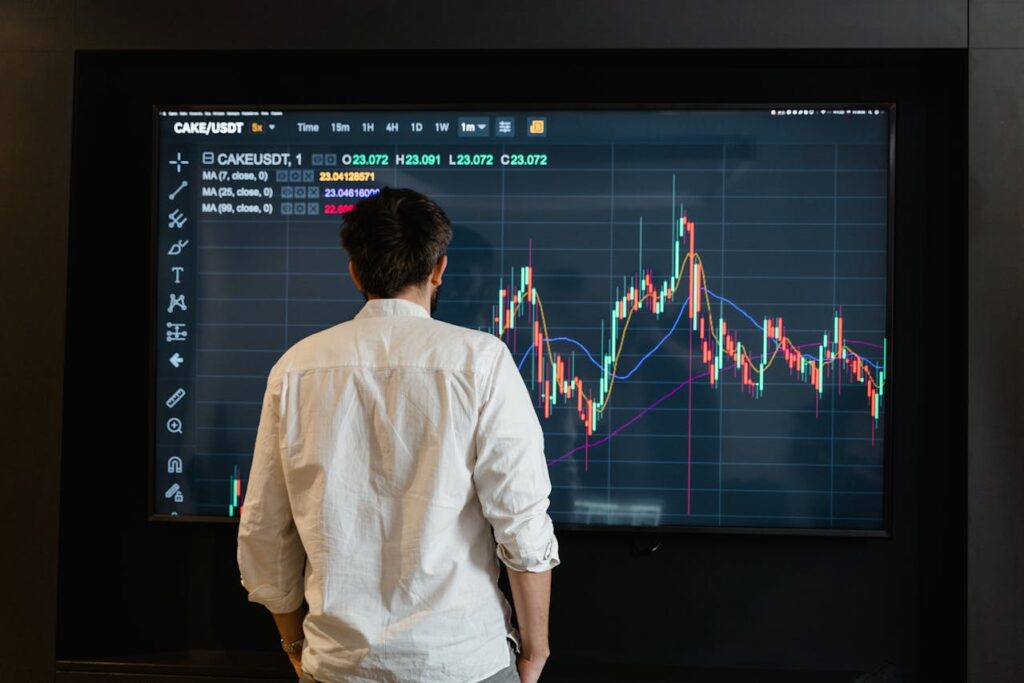
Technical analysis helps traders make better decisions by analyzing past price movements. It focuses on identifying patterns, trends, and key price levels to predict future price action. Traders use chart patterns, trend analysis, and market analysis to find potential trade opportunities.
Forex indicators are tools that simplify technical analysis by providing signals based on price data. Some of the most commonly used indicators include:
- Moving Averages: Helps identify the direction of a trend.
- Relative Strength Index (RSI): Measures whether a currency pair is overbought or oversold.
- Bollinger Bands: Shows market volatility and potential breakout points.
- MACD (Moving Average Convergence Divergence): Detects trend changes.
Using forex indicators with other trading tools can improve decision-making and reduce unnecessary risks. Many trading platforms provide built-in indicators that help traders perform market analysis without external software.
Traders also use forex calculators to measure risk before making a trade. When combined with strong risk management, technical analysis can help traders find the best entry and exit points. Understanding price action and using reliable trading software ensures that traders can react quickly to market changes.
5. Forex Signals & Trend Analysis
Forex signals help traders by providing trade suggestions based on market conditions. These signals include entry and exit points, stop-loss levels, and take-profit targets. Traders receive forex signals through trading platforms, automated systems, or professional analysts. Signals are based on technical analysis, market analysis, and price action to ensure accuracy.
There are two main types of forex signals:
- Manual signals: Generated by experienced traders who analyze chart patterns and market trends.
- Automated signals: Created by trading bots using trading software and pre-set algorithms.
Trend analysis is another key tool in risk management. Traders study past price movements to determine if a market is trending up, down, or moving sideways. Technical analysis helps identify trends by using forex indicators such as moving averages and the Relative Strength Index (RSI).
Strong trends often result in higher trading accuracy. By following trend analysis, traders can improve their order execution and reduce risky trades. Understanding currency pairs and working with brokers that use reliable liquidity providers can also improve trading efficiency.
6. Trading Bots and Automated Risk Management
Trading bots are automated systems that execute trades based on predefined rules. These bots use technical analysis, market analysis, and forex indicators to identify trading opportunities. Many bots are integrated into trading platforms and operate without human intervention, allowing traders to execute trades faster and more efficiently.
Automation helps traders maintain consistent risk management by enforcing stop-loss and take-profit levels. Bots reduce emotional decision-making and follow strict rules based on price action, trend analysis, and historical data. This ensures better order execution and limits unnecessary losses.
There are different types of trading bots:
- Algorithmic bots: Execute trades using pre-set formulas based on chart patterns and market conditions.
- Copy trading bots: Mirror trades from experienced traders, providing signals in real-time.
- High-frequency trading bots: Place multiple trades within seconds, leveraging market inefficiencies.
While trading bots can improve efficiency, they are not risk-free. Poorly designed bots may fail in unpredictable market conditions, leading to losses. Traders should test bots on demo trading platforms and ensure they work with brokers that offer reliable liquidity providers.
7. Liquidity Providers and Their Role in Risk Management
(Liquidity providers, Currency pairs)
Liquidity providers are large financial institutions that offer buy and sell prices for currency pairs. Choosing a broker with strong liquidity providers ensures that trades are executed quickly and at fair prices.
How It Helps:
- Reduces slippage (the difference between expected and actual trade price)
- Ensures fast order execution, even in volatile markets
- Helps traders avoid unnecessary losses
Tip: Always trade with a regulated broker that offers deep liquidity for smoother trade execution.
How to Use These Tools Together for Better Risk Management
Now that we have covered the key risk management tools, here is how traders can combine them for better protection:
- Use a forex calculator to determine the right trade size.
- Set a stop-loss order before placing a trade.
- Follow trend analysis and forex indicators to find good trade setups.
- Use a reliable trading platform with strong risk management features.
- Avoid high slippage by choosing brokers with good liquidity providers.
Risk management is one of the most important parts of forex trading. Without it, even the best traders can lose money quickly. Using the right forex trading tools—like stop-loss orders, trading platforms, forex calculators, and technical indicators—can help traders control risk and trade smarter.